Showing posts with label Ideas. Show all posts

Wednesday, 27 January 2016

Artist Studios: Keeping Creativity in the Capital

'It's an increasing struggle to maintain a practice that isn't funded in a commercial way' says Emma Hart, an exhibiting artist living in London who has shown at Folkestone Triennial, Whitechapel Gallery, Camden Arts Centre and Matt's Gallery.

Emma is at London Art Fair for the first time - not as an exhibitor but as a panellist. She's here to discuss the role that artists play in the creative reputation of the capital and what can be done to keep them here in the face of rapidly rising rents.

In November, Hart was awarded £50k by the Paul Hamlyn Foundation through its Awards for Artists. If that hadn't happened, she says, "I would have had to consider a move out of London." But she doesn't want to leave. She's a Londonder. Her family live here. As it is she has already just had to move South to Peckham from the East.

Behind the panel is a map showing applications to Whitechapel Gallery's triennial London Open exhibition in 2012. It's a fairly even spread across the boroughs. But when compared with the 2015 map a number of factors become apparent. This by no means a scientific data set, but there is a marked shift in applications from West to East, and from inner to outer. An increased number of applications from outer boroughs may, says curator Daniel F Herrman, be attributed to changes in eligibility, but it's where the dots no longer exist that is a concern. I hadn't expected to see such an effect in so a short space of time.

"We all have anecdotes of artists we know who have left for other cities" says Ben Luke, the Evening Standard's Art Critic, including other European capitals such as Berlin. Recent statistics compiled by artist's newsletter (a-n) have shown that artists in the UK earn an average of just £10k a year. "That's just £3 an hour" says Luke, "a third of the London Living Wage".

This means that artists are very rarely full time - subsidising their work through a variety of other income streams including teaching. "10 years ago succesful artists were going into studios paid for by themselves." says Hart who also teaches at Central Saint Martins, "Now even Turner prize winners are moving back into supported studios. Many are coming back to teach."

Hart's studio in Peckham is managed by [Space Studios], an organisation that rents out around 500 spaces to artists in the capital. While they own some of their properties outright, those that they lease have seen rent rises of as much as 400% in recent years.

Also on the panel is Fabio Altumura, Gallery and Development Manager for Cubitt, an artist run co-operative based just around the corner in Angel. Cubitt sustains its studios through rent and other initiatives while receiving Arts Council funding for its gallery and education programme. "I keep meeting artists who can't afford to be artists" he laments.

In 2014 the Greater London Authority's Cultural Strategy Unit estimated that as many as 3,500 artists are likely to lose their places of work in the next 5 years - 30% of the 11,000 practicing artists they found currently provided for by 298 separate studio buildings or sites. Only 17% of these spaces are freeholds.

So what can be done to help these spaces which are under so much pressure from a grossly inflated commercial property market?

The panel turns Kirsten Dunne, the senior Cultural Strategy Officer at the GLA who comissioned this research. Can politics play a role? Might there be some provision for studios under affordable housing quotas?

Probably not under curent planning laws, she responds. "Housing is the biggest issue facing Londonders today", she remind us. London needs more homes, but it also needs more infastructure to support it's growing population - schools, hospitals, energy, green spaces. Councils accross London are under a lot of pressure. (In fact if you visit Big Bang Data at Somerset House this month there's a fantastic interactive installation which puts you in the place of decision making around these issues.)

But Dunne and her colleagues at the cultural strategy unit, headed up by Munira Mirza, have been building the case for artists' contribution to the capital, and are talking to London boroughs and developers to keep culture at the heart of the city. "Studios are a really viable model because artists are brilliant at paying" says Dunne, who is now researching alternative forms of funding.

There is a lot of evidence, however, that "artists are the victims of their success", says Luke. They move into new areas, start squatting and make the area popular. "We don't benefit from that value that we create" underlines Hart "I can't afford the rents that I have apparently made bigger."

Altumura recalls an interview with David Byrne in the New York Times. "There's this romantic vision of artist struggling in big metropolis," he says, "It's not romantic, is a struggle. How much cultural capital has been established on artists not being paid? We need to put value on what we are dealing with."

So what happens when artists can't afford to be artists and what does it mean for an area if only a certain economic class of artist can afford to stay?

Living in New York, Altumura witnessed first hand the hollowing out of the city. "New York has lost most of artists to West Coast" he says "and this impacts on the art that is being made."

"If only those with money start taking up art in the first place, that skews everything because there is a lack of diversity." says Hart "We (artists) can't make links into communities if we are always on the move and we can't put down roots ourselves."

"Institutions need artists nearby too" says Herrman on behalf of the Whitechapel Gallery. If artists and cooperative organisations are priced out "then it creates a monoculture of criticality and creativity" he warns "and I think that would make London far less attractive as a place for tourism, for thinking, for living and defiantly as a place for growing. We, as institutions, are keen on diversity."

So what can be done?

All of the panel agree that artists and arts leaders have a role to play in highlighting the problem and advocating for alternatives.

"Artist co-ops such as Cubitt are an extremely beneficial model for other forms of co operative organisation" says Herrman.

"I'm always been amazed by how resourceful artists are and can be" agrees Altumura "as long as they have the basics covered such as affordable living and an affordable studio.We need to enable more artists have their opinions heard and to allow artists to be in a position to do what's best for them."

"I remember an article saying that it's standard procedure to have a business person on the board of arts organisation" posits Dunne "but it's not standard procedure to have an artist on the board of each business organisation. That would certainly be a recognition of value."

"I would like to start hearing arguments which go beyond how much money artists make and how many jobs they create." says Hart "For me that would be a critical space and a more fundamental debate about what art really does and what we need. We need to go beyond talking about art in just financial terms."

"Berlin is not just interesting an interesting place to work because rents are cheap" says Herrman "Rents are controlled. Since the 1988 housing act there is a lack of tenancy protection (in the UK), be it for artists or the general population, which incentives speculation over long-term tenancies. That is not the case in many other countries."

In more immediate terms, a new £20m London Regeneration Fund has just announced by the Mayor's office. It includes provision for artist studios and work space which should at least start "to dent the shortfall" says Dunne. Funding for new creative space includes Cell Studios in Hackney Wick, The Bow Packing Works, two industrial sheds in Enfield and the ground floor car park of a Magistrate’s Court in Richmond.

Dunne also points to a few tentative schemes which tether affordable housing to affordable workspace, such as Hackney Wick Fish Island, and to developers, such as Peabody and Grovesnor, who she says do have an understanding of the long-term benefits of community. She is also keen to highlight best practice in councils such as Waltham Forest, who she says want to embed culture in their communities.

But, as she and Hart both agree, a lot of this relies on a shared understanding of what exactly is "affordable". If you read the property pages of the London Evening Standard, the current definition offered by London developers seems to be £350,000-£400,000+ for a two bedroom flat through a shared ownership scheme. I can't afford that, and I'm not even an artist.

Chris works for London Art Fair and Paul Hamlyn Foundation Awards for Artists as an Account Director at Four Colman Getty. He convened this panel on behalf of London Art Fair but any views expressed in this article are personal or those of contributors.

Wednesday, 25 November 2015

The Invention of News

A lot happened in the western world between the 15th and 18th centuries. 'The Invention of News' spans four hundred years that saw the Reformation of the church, the expansion of global trade routes, spawling international conflicts and unprecedented poltical revolutions.

With all this going on, it's unsurprising that a market for information developped within populations that were increasingly literate and interested in current affairs. Yet despite Gutenberg's breakthrough with the moveable type press in 1439, for much of this period the newspaper was not the primary method of delivery. Not 'invented' until around 1600, it was in fact more of a product of these times than their herald.

Petegree's book is an study of the diversity of the information landscape into which newspapers emerged. Not dissimilar, he notes, to the blending of various forms of print, broadcast and digital media over the last 100 years.

Pre-Gutenberg, news would travel through a large illiterate population by word-of-mouth, or through court messangers employed by those few people who could afford them. The personal reputation of trusted sources was key.

The forerunners of printed news were hand-written manuscript services used by Italian merchants in the 16th century to keep abreast of international affairs and changing prices for goods which might affect their business. These Avissi would collate verbal reports and written correspondence from foreign cities in the order that they arrived, citing the date, city of origin, and often the personal source of the news - a practice still common in newswires.

It was this format that the first enterprising newspapers copied from the start of the 17th century. Yet the stream of data would come with no context, explanation or analysis. A literate population who could now afford the luxury of a newspaper might be able access information previously only available to the inner circles of power, but they might not be aware of its significance.

The marshaling of public opinion was a battle fought instead through pamphlets, which enjoyed their first explosion during the wars sparked by the Reformation and reached their frenzied peak during the French Revolution two and a half centuries later. These ephemeral publications could be produced and distributed quickly and cheaply in response to demand for news of major events. Unlike the subscription-based model of newspapers, they had no need to acknowledge their publisher in the interest of repeat business, and so could be far more liberal in their often contentious opinion.

It is no coincidence that such developments went hand in hand with the emergence of Europe from a feudal system into a place of commerce, and an awakening of conciousness which saw people question first the church, then the rights of their rulers and eventually their own role in civil society.

In fact the potential to excite the population was one quickly recognised by civil authorities, who initially imposed strict copy-checking policy on very closely controlled monopolies, as in the Netherlands, or even completely  nationalised the press, as in the case of The Gazette in France. In this climate, when one word wrong could leave to arrest, many printers were initially happy to restrict their content to the coverage of less contentious foreign affairs.

The most notable exception the rule was England where, following the English Civil War and subsequent Glorious Revolution, a unique news ecology developped which saw publications effectively bought as propoganda tools by rival political parties. The French and American revolutions saw later relaxation of domestic news coverage - albeit temporary in the case of the former.

One of the major strengths of Petegree's book is an ability to link the development of news with the emergence of other industries of the time, including financial markets in the 18th century, first evidenced in the Tulip crisis and South Sea Bubble, or the establishment of coffee houses as centres of discussion and debate closely associated with the rise of other forms of journal and periodical.

Besides the printing press, the innovation most central to the establishment of regular news services was the development of a European postal network during the 16th century, to link the major trade centres of Italy and the Netherlands via the Holy Roman Empire in Germany. In an age of instantaneous alert, it is fascinating to consider how the speed of news depended for so long on the speed of horse travel - around 50 miles a day with the fastest couriers - often delayed indefinatley by rough sea crossings and political turmoil. It took until the early 18th century for printed news to establish itself as a regular feature in daily life.

Petegree also examines the role of advertising, in introducing domestic news and affairs into the pages of newspapers through the first personal and business ads.

One of the most charming aspects of the book is its ability to illustrate the times in which it trades, calling on first hand accounts of consumers of news as well as contemporary reportage and insight into the lives of news producers and distributors. The way in which superstitious tales tales of strange occurrences give way to more factual reports is evidence of a mankind's changing awareness of the world at this time. Yet it some news, such as battle reports, gruesome murders, moral tales and societal gossip, remain of timeless interest.

This is a fascinating and illuminating history which explores a momentous period of political and economic development towards the world we live in today through contemporary sources and perceptions. It successfully paints a complex picture of the news ecology, while demonstrating how the interest in, market for and presentation of information developped in tandem with commercial growth, civil engagement and enlightenment thinking. There were a few times when I found myself wondering whether I needed the depth of study provided on certain topics, but these were far between and recompensed by the quality of research and the lucidity of the greater narrative. 

Excellent.

Wednesday, 4 March 2015

Have you ever seen a smeuse? How would you know?

Print by Stanley Donwood

'We are making do with an impoverished and increasingly homogenized language to describe the landscapes outside of our cities' says Robert Macfarlane, author of Mountains of the Mind, The Wild Places and The Old Ways. He's at the Foyles on Charing Cross Road, talking about his new book Landmarks. To prove his point, he turns to the Junior Oxford English Dictionary which in 2007 removed seemingly essential words such as dandelion, nectar and cauliflower to be replaced with others such as broadband, email and analogue. Should children really learn to spell blackberry with a capital B before they've tasted the fruit?

When he's not lecturing in English at Cambridge, Macfarlane spends a lot of his time walking in and writing about these landscapes, so you might expect him to have developed a richer vocabulary for them. But the point that he's making is relevant to us all. How often have you been for a walk in the countryside and found yourself unable to name the plant, animal or distinct weather that catches your eye? What does the act of naming bring to our experience? What does it matter?

It's about cognition as much as anything, Macfarlane seems to be saying. Once you know the name for something, such as a ‘smeuse’ (Sussex dialect for ‘the hole in the base of a hedgerow made by the repeated passage of a small animal’), you're more likely to be aware of it and actually see one. He gives the example of a period in which he was reading J A Baker's Peregrine, a singular exploration of the Essex landscape in search of these beautiful raptors. Around this time Mcfarlane started seeing these birds in his own area, tuning into their presence with an awareness that he had not previously held. Language and books about nature can, he says, change the way that we see. Macfarlane's own writing, infused with the culture, history and people of the landscapes that he visits, certainly achieves this for me.

He describes a campaign to save the peat moors of Lewis, the North most of the Outer Hebredies. For the company hoping to build Europe's largest wind-farm here, it made sense to describe the place as empty and desolate. To anyone looking at pictures of these open, windswept places, that's how they seem. For locals such as Finlay Macleod, however, it's a landscape steeped in the experience of the crofters who once cut the turf from it's ground. Macleod's lexicon, included in one of nine glossaries in Landmarks, gives us phrases such as the wonderfully precise 'rionnach maoim’ (a Hebridean Gaelic term for ‘the shadows cast by cumulus clouds on moorland on a sunny, windy day’).

As I stood at the train station this morning, and realised that I was suffering 'sun-scald' from the glare of the rails, it dawned on me that it's not just our countryside that requires a richer language. Many of us can't even describe the landscape of our everyday urban environment. The Oxford Dictionary of Architecture and Landscape is a good start, but perhaps there should be a word the shadow cast by a tree upon a brick wall, for litter trapped against a fence by the wind, or the way that you can look back in time by glancing above the modern shop fronts of a high street. Maybe there already is. I've always been a fan of desire lines (that muddy corner of the grass in a park that everyone cuts to make their journey shorter).

Macfarlane wants to encourage his readers to experiment with their own language, highlighting the fun that Douglas Adams and John Lloyd had re-appropriating English place names in The Meaning of Liff. It's time, he says, to re-wild our language, and there's a page at the back of the book left blank for you to start your own lexicon. My wife and I begin with 'The Best Bits' - a phrase we use to describe those rays of sun that break through the clouds like beams of god (as an Art History graduate I'm sure I used to know the correct word for this phenomenon but it's since been supplanted. Where can I turn for a decent visual dictionary?). In the interest of linguistic diversity, I'm sure we can do better than that.

Wednesday, 17 December 2014

When algorithms fail

Craig Constantinides of Go2Games
Decisions made by pre-programmed computer algorithms are increasingly affecting our lives, and not always for the better; a point made clear by two events in the last two weeks.

An Amazon glitch between 7 and 8pm last Friday saw hundreds of products automatically plummet to a rock bottom price of 1p, at which point they were quickly snapped up by consumers already whipped into a bargain Christmas gift frenzy by media hype around Black Friday. The culprate in this case was Repricer Express - a software which promises "continuous repricing 24/7" for sellers across multiple online channels. As a seller, this is a way of ensuring that you're offering the most competitive prices for your wares without having to check on the competition yourself. Come Saturday morning, a number of people who had left the algorithms in charge found that huge amounts of stock had been given a way in a freak 1hr flash sale caused by a glitch in the software.

Whilst an algorithm stealing from Amazon will be seen by many as a kind of automated Robin Hood, redistributing riches from the greedy corporation to the poor consumer, it turns out that the online megalith won't be the one that will actually suffer. Craig Constantinides of Go2Games claimed in CityAM that £358,000 of stock had been affected. He issued pleas via Facebook for customers to return, or pay full price, for goods purchased in the giveaway. Which raises the point that although it was the machines wot gave it away, it was consumers that pounced on the bargains, unable to believe their luck. Should it be on their conscience whether they return the goods? It will be unless Repricer Express or Amazon refund all damages.

To be fair to Repricer Express, they have pointed out that there is already an automatic alert built into the software to warn retailers of any dramatic price fluctuation. This suggests that those who came a-cropper were those who chose to turn this function off and trust the machines. On the other hand the hour of the glitch could just have easily affected anyone who was doing something other than constantly check their phones 24/7.

Talking of conscience, the second crime against humanity perpetrated by the algorithms this week was courtesy of taxi app Uber. The company operates an automatic surge pricing which saw fares in the area of Sidney caught up in the hostage siege shoot up to a minimum of $100, as people tried to flee the area. A spokesperson for the company explained that the system was designed to attract more drivers to an area of high demand,  but the company quickly moved to regain their human status by offering free rides to all affected. This goes to show that behind every algorithm lies a human agent with the power to decide how it is programmed and to take responsibility for any resulting failure. The real heartless automaton of the week was the badly programmed disgrace to the Islamic faith responsible for it all, not to mention the idiots posing for selfies at the cordon.

Human agents need be held to account for any machine-made decisions, but we all need to be aware of how much to responsibility we are handing over to the automation in our lives.

Monday 9 February 2015: If you're interested in these ideas, I can thoroughly recommend Nicholas Carr's The Glass Cage, published last month by Bodley Head.

Wednesday, 1 January 2014

Best advice of 2013


Here are my three favourite pieces of advice that I can remember from 2013:

"A man who procrastinates in his CHOOSING will inevitably have his choice made for him by circumstance. So if you now number yourself among the disenchanted, then you have no choice but to accept things as they are, or to seriously seek something else. But beware of looking for goals: look for a way of life. Decide how you want to live and then see what you can do to make a living WITHIN that way of life."
Hunter S Thomson, Letters of Note

"People keep working, in a freelance world, and more and more of today's world is freelance, because their work is good, and because they are easy to get along with, and because they deliver the work on time. And you don't even need all three. Two out of three is fine. People will tolerate how unpleasant you are if your work is good and you deliver it on time. They'll forgive the lateness of the work if it's good, and if they like you. And you don't have to be as good as the others if you're on time and it's always a pleasure to hear from you."
Neil Gaiman addresses graduates at The University of the Arts, Pensilvania

"Be here now"
Sign painted onto the side of a converted schoolbus bus on its way to Burning Man Festival

As a bonus, these 10 old letter-writing tips that work for emails are pretty good too.

Sunday, 8 December 2013

Future Human: Meme Control


"You wanna get deep?" asks Watkins Tudor Jones of zef rap group Die Antwoord in a 2010 interview with The Times of South Africa. Their 2012 music video for the track Fatty Boom Boom - which combines an irreverent Laga Gaga parody with shots of rappers Ninja and Yolandi Vi$$er dancing frenetically in white and black body paint - has amassed over 15 million hits on youtube since it was first posted. Along the way it's sparked accusations of racism and prompted scathing attacks from Lady Gaga’s fans, while Die Antwoord have been head-hunted by everyone from advertisers to Hollywood.
The video was also one of the internet 'memes' up for discussion in a Shoreditch basement at  Future Human's 'Meme Control’, the last salon of 2013


So what is a meme and how deep do they get? Are they just time-wasting internet distractions or do they say something profound about the human condition?

The term was originally coined in The Selfish Gene, a 1976 book by Richard Dawkins in which he proposes that genes, like viruses, rely on humans to be passed on. “Genes are the replicators" Dawkins wrote "and we are their survival machines.” Towards the end of the book, he goes on to suggest that perhaps culture could be seen in a similar way. He created the word ‘meme’ from the root 'mimeme', Greek for ‘imitated thing’, to describe "an idea, behavior, or style that spreads from person to person within a culture”. Since then, the word has been appropriated by internet culture to explain the ‘viral’ proliferation of cat videos, animated gifs and anodyne quotes which seem to take up so much of people’s attention online. 

So what are the links between the two, and why do people share these things? Future Human’s Jack Gwilym Roberts opens the evening, updating Dawkin’s theory with some thoughts on evolutionary psychology. This is the idea that all behaviour can be traced back to primal urges - to mate, to eat, to ship our pants (20 million views). So are we, as Dawkins suggests, controlled by our memes? Does sharing demonstrate altruistic behaviour, which helps us to work and survive together as a society? Do we copy and share because we want to look good to potential mates? Or in sharing internet memes are we just breeding idiocy? Are they, like religion, just a way for us to simplify the world, to rationalise experience and relieve stress in a complex environment?


Basic emotion is a critical factor, says Holly Clarke, a former 'meme scientist' at Unruly media, who admits partial responsibility for the T-Mobile Dance (38 million views) and the Evian Babies (72 million views). Viral ads, she tells us, rely on feelings such as surprise, anticipation, fear and disgust, to stimulate a physical reaction. But it seems that as we find ourselves exposed to ever higher volumes of 'content', we quickly become numb to these provocations. It’s all about "being more epic than the last epic thing". Your viral ad needs to have “a wtf?! factor” to survive. This certainly seems to be something which Die Antwoord have understood. 


Tony Sampson, author of 'Virality', thinks that this leads less a case of survival of the fittest and more a reign of the idiot. 

'Cognition is the enemy of marketing,' someone tweets to the screen. 

“Exactly,” says Tony.

The internet is still in it's infancy, says Holly. We're still learning what to read, what to look at, and what to share. Effectively, we’re still learning how to manage our attention online. "The BBC still has lots of awful things at the top of it's most read,” she points out. Ideas which are simply ‘wacky’ quickly dissipate though. “Who’s going to care about the Evian Babies in a few years time?” asks the woman who created them. Whereas people used to share things just because they were “a stupid internet video”, now, says Clarke, people are looking for something real. Hence the increasing use of hidden cameras and user generated content in mainstream advertising. Think Kevin Macdonald and that Sainsbury’s Christmas advert. 

Maybe this is a sign that the internet is growing up? So the question is, as it matures, is the internet is going to become more responsible? Perhaps it already is, says Holly, it just depends on who's using it. She points to open data culture, while in his opening presentation Jack cites Avaaz, an online campaigning organisation with over 30m members worldwide, as an example of using the rules of memes to do good. 

One person who takes his responsibility very seriously is Stuart Calimport, founder of The Human Memome Project (great name). Stuart, who comes across as a very earnest member of the Quantified Self movement, has begun to create metrics around his own response to memes, in the Dawkinsian sense, and to compare his results with others. Unlike most marketing companies, he says his primary motivation is to look for the health and longevity predictors which they might reveal. Stuart wants to live forever and is interested in the ideas and behaviours that are going to help him get there (and you too - for the right amount of money). He believes that everyone has a 'memome', a sequence of constituent ideas and influences that has shaped their personality in a similar manner to DNA. If only we could work out how to shape them in the right way… This links back to an idea Jack mentioned in his introduction. If the brain can be seen as hardware, for the software of the mind, then perhaps memes are the code? 

Not in the eyes of Sampson, who thinks that all of this is founded on pseudo science. "Culture is not biologically determined," he tells us, and "meme is a dodgy theory… a control mechanism for a certain system of belief". The question of how ideas spread is an old one, Tony says, which can be traced back to the development of crowd theory at the turn of the 20th century and the rise of socialism and popular fascism. The transfer of ideas is really about society and about networks. Computer viruses such as ‘Melissa’ and ‘I love you’, are spread socially. 

"People will only share if they think they're the influencer" says Holly. It's about having content which engages and provokes, but it's also about seeding this content with the right people at the right time. It's about finding those key influencers who everyone else copies. 

Again Tony disagrees. Read 'Is the Tipping Point Toast?' he urges us. This is a Fast Company article by Clive Thompson, which outlines research by Duncan Watts seemingly discrediting Malcolm Gladwell’s theory that a small number of very cool people dictate the trends that everyone else follows. Gladwell based his theory on a famous 1967 study in which a sample group was asked to pass letters to a certain individual through their personal networks alone. It was found that the average number of links from sender to the recipient was six, hence the degrees of separation, but also that the majority of letters went through the hands of three key individuals. 

Interested in these ideas, Duncan Watts, a network scientist, set up a number of much bigger computer simulations to test the theory. To cut a long story short, he concluded that while the six degrees finding held true, a trend or meme could in fact be started by anyone in the network. Although it was true that those started by key influencers spread wider and quicker, there was statistically more chance that a trend would come from elsewhere. Trends, he concludes, are more akin to wildfires than viruses. Hundreds of fires take place in forests, but they only turn into wildfires when the conditions are just right. "If society is ready to embrace a trend, almost anyone can start one--and if it isn't, then almost no one can," Watts concludes. 

So it's all about creating something to match the public mood, which is exactly what Holly claims to have achieved with her viral successes - deploying retro music, rollerskates and cuteness as a killer combo. At the same time, though, I don't think we can discount the need to disseminate ideas in order for them to take off. While Watts’ computer generated results did show that an idea can start anywhere, and be carried by word of mouth, it also proves that it’s when people with large networks or audiences pick up on them that they really spread. For each of her campaigns, Holly sent the videos to people with large online followings at just the right time for them to create a surge of interest which quickly snowballed. 

I think the confusion here is with how we see these people. Yes, they are influencers, but, as with all of us who create, curate and share content online now, they are also now publishers with audiences to entertain (shows us those thumbs! Bask in the reassuring glow of those retweets!). Hence a desire for exclusive content which will spread quickly, rather than something which takes too long to digest and think about (like this blog). Which brings me to a comparison with pre-internet media. Which newspapers sell the most copies? In the UK it’s the The Sun and The Daily Mail. How do they do it? By getting exclusive stories which provoke basic emotional reactions and harness the public’s mood. 

So perhaps things really haven’t changed that much after all, and maybe it’s not the internet that needs to grow up. You might even suggest that the best way to improve our Human Memone is simply through a good education - the most effective form of memetic engineering (to extend a metaphor). I strongly believe that basic secondary education should include critical analysis (ie. thinking for yourself), media literacy (ie. being able to understand how the media works) and some understanding of the power structures of society (ie. the agenda behind it all and how to play the game). But then I guess we can’t all be as earnest as Stuart, or as pessimistic as Tony, and those cat videos really are much funnier than homework... *

*Besides, Michael Gove thinks education should be more about mnemonics than memetics, and he's in charge now.

Friday, 22 November 2013

Wrap Up London


Every morning last week I set my alarm for 5.30am and arrived at Waterloo station two hours earlier than usual to volunteer for Wrap Up London. Why? We were asking fellow commuters to give us their coats. Not literally the clothes off their backs - although a few generous and impulsive souls did just that - but old coats, unwanted ones, long forgotten winter warmers, tucked away in the backs of wardrobes or buried beneath layers of new fashion.

We spent two days telling people the plan: you donate unwanted coats on the way to work, we pass them on to London's most vulnerable so that they can keep warm this winter. It's an easy ask. All you have to do is spend five mins rummaging when you get home, then the next day carry your toasty treasure halfway to work. If you forget on Wednesday, you've still got two more days to remember. Many people got involved, often bringing bags full of ski-jackets, parkers and overcoats which they'd collected from house-mates and family members.

It's a great system. The ask and action are both simple and tangible, while the small lift of feel-good achievement experienced by donors is quite palpable. The whole transaction feels like a kind of magic. You can spot the givers in the crowd.  They're often carrying an extra bag or just moving towards you with purpose. You meet their eye and smile as the bundle is trust toward you. There's often a look, either a smile of happy benevolence or a quizzical 'is that it?'. This is the point at which I think it's my responsibility as a volunteer to convey gratitude on behalf of those who will be unable to do so themselves.

In a way it's all quite detached, because none of us meet the people who benefit at the end of the chain, but as the cold, wet weather sets in it's good to know that there are over 10,000 coats now ready to be redistributed to London's most vulnerable in shelters and refuges across the capital next month. This is all thanks to Hands on London, the organisation which manages the 100+ volunteers for Wrap Up London each year. It's a great way to volunteer because it's rewarding, it's flexible and you don't need any qualifications.

When I speak to people about volunteering, many don't know where to start. Others cite lack of time or a need to prove experience as barriers (unpaid volunteers should never require a qualification). Talking to volunteer managers, the biggest problems are often retention, finding the right people for the role and reaching new groups.

I joined Wrap Up London last year after a colleague told me about his experience. Since then I've been volunteering one evening every other week with my local Mencap. Hopefully some of the thousands of people who donated coats last week might now be inspired to look up Hands On London and give it a go.

handsonlondon.org.uk

Saturday, 5 October 2013

Un dépaysement à la mode


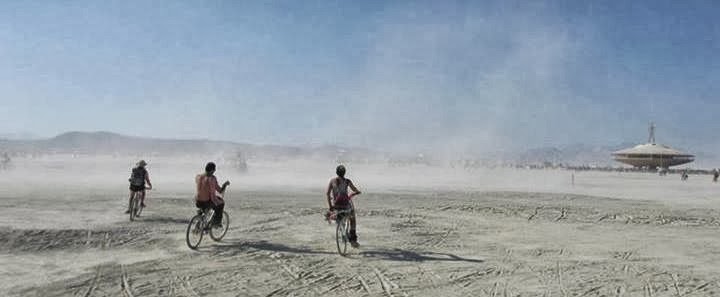
“How was Burning Man?” Everyone keeps asking me. “I bet it was epic…” 

Well, yes, it was thank you. Especially the 24 hour journey to get there; the nine hour queues in and out; the seven days living in a dust bowl; the incredible landscape; the amazing art; the music; the dancing; the people; and, of course, the giant burning spectacle at the end. But it wasn't just epic. 

When people are asked about their Burning Man experience, “I can’t put it into words” is a common response. For those who haven’t been before, this might imply smugness akin to condescension – ie. “If you’ve not been, you just wouldn’t understand” - but I think that’s rarely the intention. In fact it's often quickly followed by a string of fantastical stories. We want to share, not out of boastfulness, but because it’s human nature to tell others about our experiences out of the ordinary. 

So what is this experience that’s so hard to explain? It’s hard to say. It’s different for everyone. It’s different every time. It’s not just one experience, but the culmination of months of preparation, days of travel and a whole week of living in an extremely beautiful, yet exposed, natural environment, as part of one of the most creative and thought provoking social ecologies that you’ll ever be part of. It’s a festival guided by principles which permeate every interaction and experience that you will have there. It has its ups and downs. It is what you make of it. 

The most intimidating barrier for many people thinking about going to Burning Man is its location in the kind of environment that most of us would look to avoid rather than spend any length of time in: a flat dry lake bed in Nevada known as ‘The Playa’. The heat and dust take their toll. There are no natural structures for shelter. The alkaline dust coats everything you can see with a fine film and somehow manages to work its way into everywhere else too. The desert sucks the moisture out of you. Water and shade are the most valuable resources. On top of this you’re expected to practice radical self-reliance. You are responsible for your own water, food, shelter and survival. You have to take all this with you, or at least make provision for it before you arrive. 

If this all sounds rather off-putting, it’s because I’ve missed out the most important factor in the environmental equation: people. We’re social animals. The best way to do the festival is to join a theme camp, or to find a group to start one. You don’t have to get through life alone, and you don’t have to survive Burning Man alone: we do it together. That’s right at the core of the experience, and, to bring out the best in people, there are a number of guiding principles in play.

One of the most widely known principles of Burning Man is the gift economy. This means that you cannot buy anything there, with the notable exceptions of ice and coffee (both luxuries definitely help). The mistake people make is to think that this means it’s a currency free economy of barter and trade. It’s not. It’s a gift economy, which means that you are encouraged to give freely to others without expecting to receive anything in return. What can you give? It doesn’t have to be a ‘thing’. It can be a skill, a story, some food, shelter, time, friendship, compassion. Of course people take some incredible gifts, creating moments of magic as you give or receive the unexpected or the essential. It could be just what you need: a bloody mary, an ice cream, a toothbrush, a tampon, a shoulder to cry on or ear to bend. In fact the best gift can often be yourself. The attitude to adopt is “What can I do for you?” and the more thought you put into that, whether before, during or after the festival, the more you’ll get out of it. 

So we’re all responsible, not just for ourselves, but for the experiences of those around us. We’re all participants. Nothing exists in Black Rock City unless it’s taken there or created by us. There’s no such thing as a punter at Burning Man, there is no separation between the crew and the audience. The crew is the audience and vice-versa. Although there are plenty of opportunities to spectate, there are just as many chances to participate, to help make something happen. You're encouraged to express yourself and to be creative, to open yourself up to others, whether through art, interaction or discussion. You're given the freedom to be yourself, and the opportunity to discover who you could be. If you want to do it, say it, or make it, then go for it. If you don’t know what you want to do, then help someone else. 

To counteract any impulse to judge all this self expression, there's the principle of inclusion. For those who think that Burners form some strange clique or cult, you couldn’t be further from the truth. Everyone's welcome. You just have to take part. The desert could be a lonely place, especially if you're caught out in a dust storm or have an arguement with your camp mates, but the willingness of others to invite you in often redresses the balance. Don’t sit over there on your own, come and join us. Let’s be sociable. Let’s do this together. I’ll help you. 

The upshot of all this is that it creates an open and engaged social environment that is quite different to the privacy and detachment of our day-to-day lives. Throughout the week you’ll find yourself depending on others you’ve never met before, supporting strangers who need you and talking to new people about things you’ve never even told your close friends. This will all be happening in an atmosphere of riotous creativity, fantastic costumes, incredible artworks, wonderful performances, surreal moving sculptures or art cars and wild music played at earth shaking volumes. It’s an inspiring place to be and many of the experiences and conversations you have will continue to inspire you for some time afterwards. 

Such an accepting and free environment is, as you might expect, conducive to the lowering of inhibitions. Certain by-products of this attract more attention, in the way that the slightest hint of titillation excites most people, but what inhibitions you chose to lower are entirely down to you. You don't have to take all your clothes off and run around naked, but no one's going to stop you if you want to. It's worth bearing in mind, though, that while it’s a great place explore your boundaries, you still need to respect those of others. Going to Burning Man doesn’t mean abandoning your consideration in a hedonistic free-for-all. You won't make many friends if you act like a dick and you won't find yourself popular with your campmates if you don’t pull your weight. 

But then work, with the right attitude, doesn’t have to be a chore. Contributing to the domestic well being of your camp can be one of the most rewarding forms of participation. The principle of immediacy encourages you to cherish every situation, even the washing-up. See a bad luck as a challenge, see a mistake as a learning experience. 

Like responsibility to others, a responsibility to the environment is built into the mind-set. 'Leave No Trace' or LNT is a constant mantra. No litter is to be left. Everyone in attendance has a responsibility to collect Matter Out Of Place (MOOP) whenever they see it. This is good practice at any festival, but it's more of a challenge when all waste, including water, must be taken home with you. You have to plan your disposal and recycling, which makes you acutely aware of just how much you generate (toilets are thankfully provided, and kept in great condition). With water in limited and precious supply, you realise just how much of it you normally waste, and how little you can get by with when you have too. It’s perfectly possible to have a body wash instead of a shower, and if you do take a (solar) shower you’re mindful of how much grey water you might be producing. Once the festival’s over, it’s your responsibility to clear your own camp, which you’ll be graded on by the crew who stay onsite to sweep the whole area of any human trace. If only every festival crowd could be so conscientious. 

So how was my Burning Man? 

Well, it was my honeymoon. I proposed to my wife the last time. The experience inspired to embark on life's greatest adventure with her. Our plan this year was to make sure that we enjoyed everything together and we did. 

As in 2011, we joined The Fireworks Collective, a group of fire performers formed each year from the UK to take part in the fire conclave before the man burns. It was the first year the collective has created its own theme camp, Albion - quite a feat for a group of people who live at opposite ends of another country. The camp experience brought the group closer together, bonding through shared endeavour, and we performed some of the best fire shows I’ve been part of. 

Although we helped out at Albion, setting up camp, cooking meals, training and hosting an English Tea Party together, Danielle and I actually camped with our long-term playa family at Pink Heart. Now one of the most recognised landmarks on the Esplanade, the inner circle of camps around the man, Pink Heart embodies the ethos of the festival. At its most simple the purpose of the camp is to provide shelter - shade, cushions, sofas – and to gift water – ice cold and flavoured with refreshing cucumber, which we serve to all comers 24/7. Whilst it might seem seem simple, the gifting of the two most essential commodities in a desert environment is immensely rewarding. The interaction opens you up to the whole festival, as people arrive seeking respite and stay to talk about their experiences, to share their stories. Through these conversations I find that I experience far more than I could ever manage on my own. Oh, and three afternoons of the week we also gave out vegan coconut-milk ice cream. A whole truck-full in three different flavours. You've never seen so much joy.

I’m sitting out the front of Pink Heart one evening talking to a Belgian guy who I’ve just met. In front of us the dark expanse of the desert is animated by a thousand neon lights. All manner of possibility is out there. "This really isn't like any other festival," I declare. “Why do you think that is?” “I don’t know the word for it in English”, the Belgian guy replies, “but in French I guess we’d call this a 'dépaysement'. A relocation to a place that gives you a different perspective on your life.” A change of scene, but also a change of mental state. And that's the part that's hard to explain to someone who's not been here. But I realise that the people who inspire me the most are the ones who don’t only make amazing things happen in the desert. They take what they find here, apply it to their lives and introduce it to the lives of others. That's really what this is all about.